Why Good Technology Is Not Enough: Positioning for Defence SMEs
Updated: 1 day ago
European defence has no shortage of technically strong SMEs.
Many have excellent engineers, differentiated products and technologies with clear military relevance.
Yet technical quality alone does not determine whether a company enters a consortium, integrates into a prime contractor’s supply chain, wins a procurement opportunity or becomes part of a long-term capability programme.
The ecosystem evaluates the company around the technology.
That includes its role, reliability, legal structure, industrial readiness, relationships, ability to integrate and capacity to deliver.
For defence SMEs, positioning is the process of making those elements coherent.
Overview
What Positioning Means
Positioning is often confused with marketing.
In European defence, it is much more practical.
Positioning answers five questions:
What problem do you solve?
Where do you fit in the capability architecture?
What role can you perform inside a project or supply chain?
Why should another organisation work with you?
What evidence supports that claim?
A company can have excellent technology and weak answers to all five.
That creates friction.
Potential partners may like the product but remain uncertain about:
integration;
commercial role;
IP;
production;
reliability;
long-term fit.
Strong positioning reduces that uncertainty.
It allows another organisation to understand quickly where the SME belongs.
Product Fit and Capability Fit
A product can be technically impressive without aligning with a current defence priority.
Capability fit asks a wider question:
How does the technology contribute to a military capability?
For example, a sensor company may describe:
resolution;
range;
weight;
power consumption;
image quality.
A capability-level description may focus on:
persistent surveillance;
target detection;
counter-UAS;
maritime situational awareness;
operation in GNSS-denied environments.
Both descriptions are useful.
They serve different purposes.
European programmes and industrial partners often organise work around capability areas rather than product categories.
The European Defence Fund reflects this structure through annual calls covering areas such as:
air combat;
ground combat;
naval combat;
cyber;
space;
energy resilience;
disruptive technologies;
sensors;
unmanned systems.
A company should therefore be able to move between two levels:
product language;
capability language.
The Company Behind the Technology
A defence partner evaluating an SME is also evaluating execution risk.
This includes basic questions:
Who owns the company?
Who owns the IP?
Where are critical components sourced?
Can the company sign and execute a multi-year agreement?
Does it understand export controls?
Does it have appropriate cybersecurity?
Can it support audits and documentation?
Can it deliver repeatedly?
Can it increase production?
These questions become more important as projects grow.
The official EU definition of an SME considers headcount, turnover and balance-sheet size, together with ownership relationships to partner or linked enterprises.
For EU programmes, corporate structure can directly affect eligibility.
For industrial partners, it affects risk.
This is why defence readiness begins inside the company.
Consortium Positioning
A consortium has its own internal market.
Every partner competes for:
budget;
technical scope;
leadership;
IP;
visibility;
strategic relevance.
The best consortium position is usually the one where the company performs a role that is both clear and difficult to replace.
Examples include:
owning a critical subsystem;
providing unique operational data;
leading a testing activity;
integrating a specialised technology;
providing manufacturing capability;
leading a clearly defined task.
Weak positioning often sounds like:
“We can support AI.”
“We can help with software.”
“We are flexible.”
“We can contribute where needed.”
Strong positioning sounds different:
“We provide the onboard perception module and will lead integration and validation against the project’s autonomous navigation requirements.”
The second version is easier to evaluate.
It also gives the company a stronger basis for budget and responsibility discussions.
EDF eligibility rules make consortium structure important from the start.
The 2026 Info Days materials, for example, distinguish between different call types, including dedicated SME calls and SMERO calls with specific consortium requirements.
The company should therefore decide its desired role before consortium negotiations are advanced.
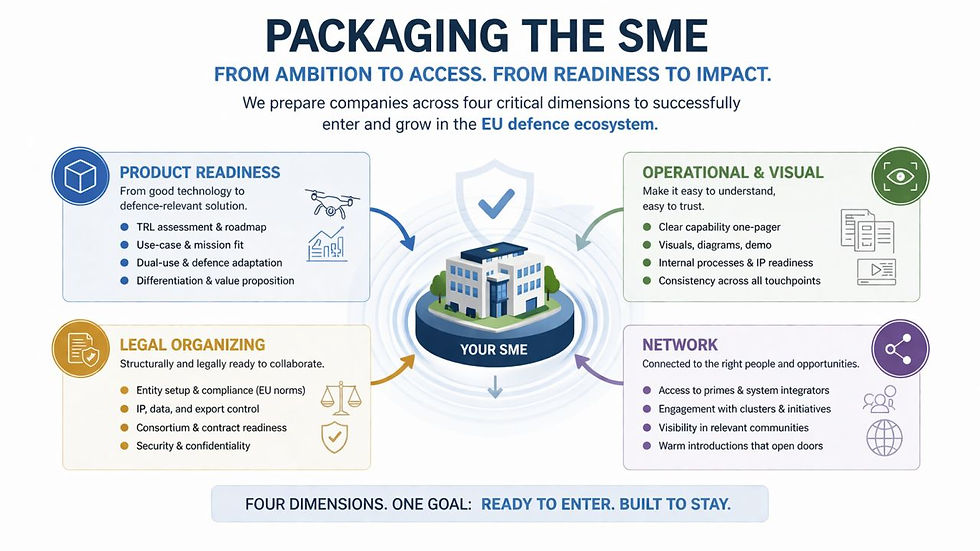
Industrial Positioning
Defence ecosystems are built around value chains.
An SME rarely needs to produce the entire system.
It needs to know which layer of the system it can own.
Possible positions include:
component supplier;
subsystem supplier;
software layer;
payload provider;
manufacturing partner;
integration partner;
testing provider;
maintenance provider;
complete product supplier.
This becomes especially important as EU defence policy moves further into industrial scale.
EDIP is explicitly focused on production capacity, industrial resilience and steady supply of military equipment.
A company seeking long-term industrial integration should be able to explain:
where it enters the supply chain;
who integrates its product;
what interfaces are required;
what volume it can deliver;
where its dependencies sit;
how the relationship can scale.
Operational Credibility
Defence technology is ultimately judged in use.
Operational credibility can come from:
military testing;
deployments;
end-user feedback;
field demonstrations;
exercise participation;
credible simulated environments.
The objective is to show that the company understands the operational problem.
This often requires more than performance data.
Military users may care about:
deployment time;
maintenance;
operator workload;
training;
communications;
logistics;
weather;
electronic warfare;
integration;
repair;
safety.
A company that understands these constraints communicates differently.
It becomes easier for military users and industrial partners to imagine the technology inside an actual capability.
Legal and Compliance Readiness
Compliance issues often appear late because they are less visible than product development.
They can still stop a partnership.
Depending on the company and programme, relevant areas may include:
ownership and control;
IP rights;
security restrictions;
export controls;
sanctions;
data management;
cybersecurity;
procurement rules;
programme-specific eligibility.
The exact requirements vary.
The important point is preparation.
If a consortium asks for ownership data or IP confirmation two weeks before submission, the company should already have the answer.
If a prime contractor starts supplier due diligence, the basic corporate package should exist.
This turns compliance from a crisis into a routine process.
Visibility and Trust
European defence is relationship-intensive.
Companies are more likely to receive invitations when people already understand what they do.
Visibility can be built through:
industry events;
programme brokerage;
technical workshops;
EUDIS matchmaking;
accelerators;
research projects;
industry associations;
direct relationships.
EUDIS Matchmaking is explicitly designed to connect innovators with corporates, investors and defence end-users.
The value of visibility increases when the positioning is clear.
Repeated exposure to an unclear message creates confusion.
Repeated exposure to a clear message builds recognition.
That is why content, events and meetings should reinforce the same company narrative.
The Positioning Gap
A useful way to assess a company is to compare technology readiness with company readiness.
Technology readiness may include:
TRL;
performance;
prototype maturity;
testing;
IP;
technical roadmap.
Company readiness may include:
corporate structure;
defence use case;
partnerships;
consortium role;
compliance;
industrial capacity;
market access.
The gap between the two creates risk.
A company at TRL 7 with no defence relationships may struggle more than a TRL 6 company already integrated with an end-user and system partner.
Likewise, a company with strong consortium visibility but weak technology evidence eventually encounters its own limit.
Both sides have to develop.
Practical Company Action Plan
Write Your Positioning Statement | Use four lines:
Avoid slogans.Make it operational. |
Build a Capability Map | Place your product inside a larger system. Identify: upstream dependencies; downstream users; integration points; complementary technologies; potential competitors. |
Define Your Preferred Role | Choose the role you want to become known for. Examples include: specialist subsystem provider; software integration partner; operational validation partner; manufacturer; complete product provider. |
Audit Company Readiness | Check: ownership; IP; contracts; security; export controls; financial documentation; production data; quality processes; key supplier dependencies. |
Build Proof | Create one evidence package containing: technical metrics; tests; military feedback; customer traction; production capacity; team competence; integration results. |
Map Target Organisations | Identify: five primes or integrators; five complementary SMEs; five potential end-users; three programmes; three events; relevant investors. |
Align Every External Touchpoint | Your: website; pitch deck; EDF profile; event introduction; LinkedIn; partner email; should all describe the same company. |
Review Quarterly | Positioning changes when the company changes. New tests, customers, production capacity or partnerships should update the narrative. |
Good technology creates potential.
Positioning determines how easily the ecosystem can use that potential.
The strongest defence SMEs make both visible: a credible capability and a company that others can confidently integrate.